McGraw-Hill's Engineering Companion

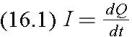
The entities of electricity are called electrons. Each electron carries a charge Q = 1.59 10 ?19 coulomb. When electrons are set in motion, they produce an electric current denoted by the letter I or i. Electric current is measured in amperes and is equal to the charge in coulombs passing a given point per second, or
The symbolic notation for current is an arrow ?.
The agency which can set electrons in motion is called electromotive force (abbreviated emf and denoted by the letter E or e). The unit of electromotive force is the volt. There are several sources of emf, of which the following may be mentioned:
The motion of a metallic body in a magnetic field. (This is the agency which creates emf in rotating electrical machines.)
The change in the value of a magnetic field in the neighborhood of a metallic body. (This is the agency which creates emf in transformers.)
Chemical reactions. (These are the cause of emf in storage batteries.)
Light. (This is the cause of emf in photoelectric cells.)
Heat. (This is the cause of emf in a junction of two unequally heated metals.)
Pressure. (This is the cause of emf in certain crystals subject to mechanical pressure.)
In electrical engineering, it is customary to distinguish between two types of emf sources,...