McGraw-Hill's Engineering Companion

DIRECT-CURRENT CIRCUITS

11 Circuit with One Resistance.

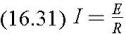
Consider a circuit (Fig. 16.1) in which direct voltage E is impressed on a resistance R. In order to determine the current I, use is made of Ohm's law. Thus E = IR, and


12 Circuit with One Inductance.

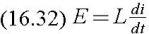
The circuit in Fig. 16.3 consists of a direct voltage E impressed on an inductance L. Equation (16.10) is used to determine the current i:


Solving Eq. (16.32) for i,


Equation (16.33b) shows that the current i increases indefinitely when a direct voltage E is impressed on an inductance. Indeed, an inductance acts virtually as a short circuit for a constant direct emf.

13 Circuit with One Capacitance.

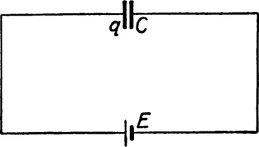
The circuit in Fig. 16.9 consists of a direct voltage E impressed on a capacitance C. Here, by Eq. (16.17a),


Figure 16.9

Equation (16.34c) states that the steady current in Fig. 16.9 is zero. In other words, a condenser acts virtually as an open circuit when a direct emf is impressed on it.

Since an inductance acts as a short circuit and a condenser acts as an open circuit whenever a direct emf is impressed on them, they will be considered as nonadmissible characteristics in this section. The section will be devoted, therefore, to series, parallel, and series-parallel circuits of resistances only.

14 Series Circuit with Several Resistances.

In the circuit in Fig. 16.10a, there are n resistances R 1,

UNLIMITED FREE
ACCESS
TO THE WORLD'S BEST IDEAS

SUBMIT
Already a GlobalSpec user? Log in.

This is embarrasing...

An error occurred while processing the form. Please try again in a few minutes.

Customize Your GlobalSpec Experience

Category: Inductance Standards and Decades
Finish!
Privacy Policy

This is embarrasing...

An error occurred while processing the form. Please try again in a few minutes.