McGraw-Hill's Engineering Companion

Chapter 8: Mechanics of Fluids

NATURE OF FLUIDS

Fluid is a substance that deforms continuously when subjected to a shear stress, no matter how small that shear stress may be. A shear force is the force component tangent to a surface, and this force divided by the area of the surface is the average shear stress over the area. Shear stress at a point is a limiting value of shear force to area as the area is reduced to the point.

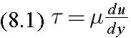
The relation between the shear stress ? and the rate of angular deformation for one-dimensional flow of a fluid du/dy is given as


where the proportionality factor ? is the viscosity of fluid.

The viscosity of a gas increases with temperature, but the viscosity of a liquid decreases with temperature. For ordinary pressures, viscosity is independent of pressure and depends on temperature only. For very great pressures, gases and most liquids have shown erratic variations of viscosity with pressure. The viscosity ? is frequently referred to as the absolute viscosity or the dynamic viscosity to avoid confusing it with the kinematic viscosity v, which is the ratio of viscosity to mass density:


Fluids may be classified as newtonian or nonnewtonian. In a newtonian fluid, there is a linear relation between the magnitude of applied shear stress and the resulting rate of deformation [ ? constant in Eq. (8.1)], as shown in Fig. 8.1. In a nonnewtonian fluid, there is a nonlinear relation...

UNLIMITED FREE
ACCESS
TO THE WORLD'S BEST IDEAS

SUBMIT
Already a GlobalSpec user? Log in.

This is embarrasing...

An error occurred while processing the form. Please try again in a few minutes.

Customize Your GlobalSpec Experience

Category: Rheometers
Finish!
Privacy Policy

This is embarrasing...

An error occurred while processing the form. Please try again in a few minutes.