McGraw-Hill's Engineering Companion

SOURCES OF EMF: GENERATORS

53 Electromagnetic Induction

Faraday discovered that when relative motion exists between a metallic conductor and a magnetic field, an emf is induced in the conductor. The magnitude of this emf is


where

e

=

voltage induced between the terminals of the conductor

( )

=

flux density of the magnetic field in a direction perpendicular to the axis of the conductor

l

=

length of the conductor

?

=

relative velocity of the conductor and the magnetic field

The essential limitations of Eq. (16.151) are as follows:

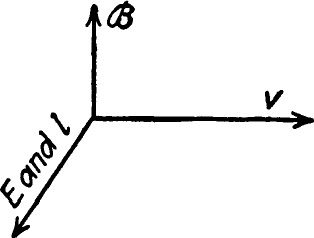
  1. ( ), v, and I shall be directed along three mutually perpendicular axes, as shown in Fig. 16.38.


    Figure 16.38

  2. ( ) shall be uniform along the entire length of the conductor, but not necessarily uniform along the direction of v.

  3. Since the velocity v is relative, it is immaterial whether the conductor or the flux performs the motion. As a matter of fact, in most commercial alternators the conductor is stationary while the field revolves. In continuous-current machines, however, the flux is stationary and the conductor revolves.

54 Single-Phase Alternators

Sine voltages are produced by machines called alternators which utilize Faraday's law of electromagnetic induction. In order to make this statement more real, the following brief description of such a machine is given.

Figure 16.39 shows a cross section of four magnetic poles marked N (north pole) and S (south pole). These poles are mounted on a shaft and are free...

UNLIMITED FREE
ACCESS
TO THE WORLD'S BEST IDEAS

SUBMIT
Already a GlobalSpec user? Log in.

This is embarrasing...

An error occurred while processing the form. Please try again in a few minutes.

Customize Your GlobalSpec Experience

Category: Electric Brakes
Finish!
Privacy Policy

This is embarrasing...

An error occurred while processing the form. Please try again in a few minutes.