McGraw-Hill's Engineering Companion

Chapter 12: Automatic Control

INTRODUCTION

The purpose of an automatic control on a system is to produce a desired output when inputs to the system are changed. Inputs are in the form of commands, which the output is expected to follow, and disturbances, which the automatic control is expected to minimize.

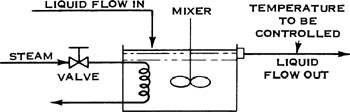
The various aspects of automatic control can best be described by use of an example. Consider a process such as that shown in Fig. 12.1. The flowing liquid is to be heated to a desired temperature by steam flowing through heating coils. The temperature of the exit flow is affected by factors (process variables) such as the temperature of the incoming liquid, the flow rate of the liquid, the temperature of steam, the flow rate of steam, heat capacities of the fluids, heat loss from the vessel, and mixer speed.


Figure 12.1: Simple heat-exchange process. ( From Perry et al. [1])

1 Open-and Closed-Loop Systems [*].

The system shown in Fig. 12.1 is normally classified as "open-loop." Open-loop control systems are those in which information about the controlled variable (in this case, temperature) is not used to adjust any of the system inputs to compensate for variations in the process variables. The term open loop is often encountered in discussions of control systems to indicate that the uncontrolled process dynamics are being studied.

A closed-loop control system implies that the controlled variable is measured and that the result of this measurement is used to manipulate one of the process...

UNLIMITED FREE
ACCESS
TO THE WORLD'S BEST IDEAS

SUBMIT
Already a GlobalSpec user? Log in.

This is embarrasing...

An error occurred while processing the form. Please try again in a few minutes.

Customize Your GlobalSpec Experience

Category: Flow Controllers
Finish!
Privacy Policy

This is embarrasing...

An error occurred while processing the form. Please try again in a few minutes.