|
|
||
|
From Video and Media Servers: Technology and Applications, Second Edition
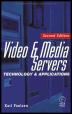
OverviewThe past several years have placed an increasing burden on I/O subsystems, the direct result of an insatiable appetite for increased storage requirements for more data. This creates a growing number of applications, demanding larger blocks of data, based largely upon client requests addressed over networked servers. Dealing with this demand has spawned new protocols, new hardware, and renewed interest in serial storage architectures. This chapter will deal with the functions and technical details of Serial Storage Architecture a serial connectivity implementation for the transfer of large blocks of data, based upon established SCSI protocols. Server data is expected to be available all the time. And this requirement applies to both enterprise and global servers. The same is true for the video server, which has mission-critical implementation with 100 percent up time. System reconfigurations are not possible any longer when the clients are always awake and active. Still, the users expect scalability, improved performance, virtually no down time, and ease of use. The result is a new generation of serial storage I/O technology that can be applied to network computing as well as digital video and media storage for servers and non-linear editors. New DemandsTo meet these newly defined and certainly expected requirements meant some extensions to the key technology of SCSI-2. SCSI-3 offers several improvements over SCSI-2 in many areas. SCSI-3 increases the number of devices or nodes on the SCSI bus. There is new support for Ultra SCSI, Serial Storage Architecture (SSA), and Fibre Channel. Devices and...

Copyright Butterworth-Heinemann 2001 under license agreement with Books24x7
Products & Services
SCSI adapters and SCSI controllers (SCSI cards) are computer interface cards that are installed in an expansion slot. They are used to connect the SCSI system to several devices and peripherals using a daisy chain method.
Search by Specification |
Learn more about SCSI Adapters and SCSI Controllers
Bus extenders are used to increase cable lengths for distance-limited bus protocols.
Search by Specification |
Learn more about Bus Extenders
Network cable assemblies are used in the transmission of data across networks. Choices include Fibre Channel, FireWire or IEEE 1394, GPIB, serial, parallel, patch, SCSI, Ethernet and USB.
Search by Specification |
Learn more about Network Cables
SCSI cables are used for high-speed bus connections between small computers and intelligent peripherals such as hard disks, printers, and optical disks.
Search by Specification |
Learn more about SCSI Cables
Fibre Channel products include hubs, directors, servers, adapters, etc.
Learn more about Fibre Channel Products
Product Announcements
Topics of Interest
Overview
Traditional disk storage has not kept pace with processing power performance. As computer power continues its upward spiral, Moore's Law holds merit but it doesn't seem to apply to magnetic...
(Read More)
Overview
Not long after SCSI-1 was first introduced, its drawbacks became evident. Soon the need for a more advanced interface became obvious and the industry began what would be a long cycle of...
(Read More)
Overview
This chapter begins with a look back on the perceptions of the SCSI interface as it emerged, matured and expanded its presence in the industry. As is common throughout this book, the...
(Read More)
Overview
The previous two chapters have explored the fundamentals of redundant arrays of independent disks from various angles. The details of RAID storage systems are becoming as fundamental as the...
(Read More)
Compression Technology
Video compression technology has enabled more data to be stored in much less space. The 25 Mb/s motion-JPEG (M-JPEG) systems of several years ago have now migrated to MPEG-2...
(Read More)
|
|