Video and Media Servers: Technology and Applications, Second Edition
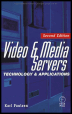
An excellent practical guide, this second edition continues to provide a technical understanding of professional digital video recording systems.
 TABLE OF CONTENTS
 Placing a video server into service involves more than connecting video and audio inputs and outputs to the rear panel and turning it on. To effectively utilize the server, a thorough understanding of the underlying architecture is necessary.
This chapter is the predecessor to a series of in-depth chapters on the internal architectures of the video server. We will begin by discussing the ground level basics of the server as it applies in the broadcast environment.
Every manufacturer has its own particular way of making its server function. Some offer a very basic one- or two-channel device that is intended for the simpler functions such as record, library, cache, and playback. These servers have limited expansion and are marked for a price niche rather than from an expansion perspective. This is not to say that this type of server is any less capable of producing images from disks, but it was designed for streamlined operations without a heavy initial price point.
We are not going to delve deeply into the specific manufacturer configurations for video servers, for many reasons. To do so would mean we'd have to leave several servers off the list, which wouldn't be fair. Alternatively, we'd have an oversized book that would read like a catalog and would be obsolete in only a year or two.
Another reason for not covering all the flavors of servers is that the technology and the internal architectures of servers are changing regularly. If we covered the way...