Video and Media Servers: Technology and Applications, Second Edition
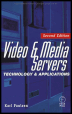
An excellent practical guide, this second edition continues to provide a technical understanding of professional digital video recording systems.
 TABLE OF CONTENTS
 Not long after SCSI-1 was first introduced, its drawbacks became evident. Soon the need for a more advanced interface became obvious and the industry began what would be a long cycle of drive interface advances. The second step in our SCSI overview takes a brief retrospect of SCSI-1 versus SCSI-2 differences, then moves directly into the development and technology of SCSI-3 the next generation in connectivity and addressability.
Bandwidth, data transfer performance, and the number of large blocks of data being transported are all considerations for improving SCSI performance. While desktop, multimedia and video applications continue to grow, the need for implementation of enhanced bus performance becomes crucial. As SCSI transfer rate performance has increased, more applications are brought to market and the success of media servers for multimedia, non-linear editing, and video applications has soared.
Industry tests conducted in 1995 were already showing substantial improvements by using the newer and faster SCSI system protocols, especially as the block or file size transfer rates increased. The expectation of a future SCSI-3, under construction as early as 1993, changed the general perception that SCSI, as a command set protocol, may continue for quite some time.
The final acceptance of SCSI-2 came in 1994, when ANSI approved the X3.131-1994 standard. We recall that a major improvement from SCSI-1 to SCSI-2 was the inclusion of the Common Command Set (CCS). The final standard included some otherwise optional sections of SCSI-1, but now made them mandatory in SCSI-2.
Backward...