Video and Media Servers: Technology and Applications, Second Edition
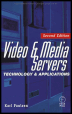
An excellent practical guide, this second edition continues to provide a technical understanding of professional digital video recording systems.
 TABLE OF CONTENTS
 Processor systems have become more reliable and more powerful. The architectures of the video I/O subsystems now provide more flexibility, including such capabilities as single encoder (inputs) and multiple MPEG decoder outputs. Around the corner, in early 2001, the server manufacturers will be offering alternative, simultaneous bit stream outputs formats with transport stream inputs over topologies including GigE, Fibre Channel, and the more conventional Ethernet for IP and ftp. The front ends of the codec systems are already allowing DVB/ASI input for "non-video" based input and outputs.
Extended capabilities are clearly moving the modern video server out of the pure "video" domain and into the true "store-and-forward" media-server domain. The consequences and advantages of new technology migration change the perspective of the physical plant in a grand way, allowing multipurposing of material stored on a single platform with only modest cost increases. The extensibility factor for media-servers therefore becomes a real consideration in the cost/benefit equation.