Video and Media Servers: Technology and Applications, Second Edition
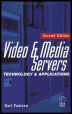
An excellent practical guide, this second edition continues to provide a technical understanding of professional digital video recording systems.
 TABLE OF CONTENTS
 The business of broadcast television has changed dramatically over the previous decade or two. The fragmentation of the audience caused by the multitude of choices in program delivery methods has forced broadcasters to take serious looks at how they manage and operate the facility. One of the foremost methods of managing costs is to reduce them and this seems to continue to be the central concept of both individual and group station ownerships.
Reducing the costs of a single station entity versus consolidation of resources among a group of stations is really two different models. One method for a single station is the limited management authorization (LMA), whereby a station literally "moves in" with an existing operation and shares physical resources as well as managerial and human resources while operating two independent program streams.
The recent movement toward consolidation has created a methodology whereby group owned stations in a regional area of the country are broadcasting from a central location, using a common master control with either independent program streams or common program streams with local inserts to feed distant broadcast markets.
The technologies available today shadow the technologies available five years ago, providing alternatives to operational models that give owners options in their operations models going forward.
Centralization of broadcast operations does not necessarily mean moving all the equipment to one location and abandoning the other facilities. Quite the contrary the entire concept is intended to be a balance between operations, technology and economics. The areas that need to be...