Video and Media Servers: Technology and Applications, Second Edition
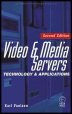
An excellent practical guide, this second edition continues to provide a technical understanding of professional digital video recording systems.
 TABLE OF CONTENTS
 In the early 1990s, we began to realize that transporting digital data to locations beyond the actual broadcast facility would require new technologies outside of conventional analog or component digital video. As new technologies surfaced, we heard about solutions that were supposed to be the saviors for connecting facilities over long distances.
As some of those technologies developed, we also learned about how difficult it would actually be to extend the current real-time model beyond the broadcast or production facility we know today. Even though solutions developed for communications (such as ATM) looked good in theory, they would bring with them a new set of problems.
The next two chapters will introduce you to the concepts of packetized data. We will hear a lot about "packetized television" over the course of the transition to DTV, as it is how we'll get digital video, audio and data into and out of servers, and then through the narrow pipe it must fit through. The foundations of packetized data transmission come out of the telecommunications industry, where they have employed the transport methods for well over a decade. We present now an overview on some of the technologies that we will be dealing with in configuring and connecting the television and production facility of tomorrow.
We have heard as many pros as cons about each of the new networking and delivery technologies. In these still early stages, where digital television is almost in our reach, but we can't quite grab it, we...