Video and Media Servers: Technology and Applications, Second Edition
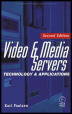
An excellent practical guide, this second edition continues to provide a technical understanding of professional digital video recording systems.
 TABLE OF CONTENTS
 Video servers are powerful tools that, when placed in a collaborative working environment, can ease the traditional burdens of the media workplace. With the capabilities of video server technology, the routine functions of acquiring, editing, archiving and managing the thousands of volumes of stories and programming-related material collected annually can be electronically organized into controllable segments for concurrent use within an enterprise.
Video servers will become a part of a common pool of resources for the production of commercials, short- and long-form programming, and promotional interstitials. The repurposing of existing material can be targeted for direct and specific messages with greater ease and flexibility.
To accomplish these tasks effectively, the systems necessary to produce program content must be configured as a mixture of on-line, near-line, and data management servers that are interconnected at both the video and the data levels. Entire video server systems, such as NewStar/EditStar and Avid Technology's Media Recorder, Media Server and Newsroom systems, are examples of how integral and central parts of daily operations within the broadcast facility can and should function.
Digital news gathering (DNG) is just one of many areas where video and media servers will excel. DNG principles can also be applied to the program production process and the instructional development processes. The concepts can be extrapolated to research, law, special interest groups, and higher education.
The structures of the processes centered on digital media servers are not necessarily unique to any one industry. To better examine how servers will fit into...