Video and Media Servers: Technology and Applications, Second Edition
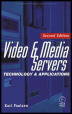
An excellent practical guide, this second edition continues to provide a technical understanding of professional digital video recording systems.
 TABLE OF CONTENTS
 Since the first hard disk drive, which was the size of two refrigerators, was developed by IBM in 1955, drive technologies have continued to advance. In mid-1998, a 2.1 GB HDD cost just slightly over $100 and was less costly per megabyte than DRAM, SRAM or even Flash. Technologies have seen the AT Attachment/Integrated Drive Electronics (ATA/IDE) become one of the more predominant interfaces for HDD. Also available are SCSI and IEEE 1394 (FireWire) and even the Fibre Channel HDD is coming into its own toward the late 1990s.
The IEEE 1394 interface offers many advantages, such as its elegant interface and the ability to attach a large number of drives; but adds higher cost in the host and device interfacing. Support for 1394 disks, in 1998, was still a long way out. The future is growing dim for 1394 as USB, Fibre Channel, IP over Gigabit Ethernet and other forms of transport begin to take hold.
For video server applications utilizing SCSI, SCSI-3 in Wide Ultra2 mode is the logical choice, offering the highest data rate of the drive/interface/mode combinations. With apologies for a less-than-up-to-date writing, every time something new comes out regarding drive storage capacity and cost, they statements seems to become obsolete by the time they are printed.
The dimensions of the rapidly changing on-line vs. off-line storage are staggering. Video servers are being purchased with upwards of 50 hours of storage in their base configurations. With the gradual phase out of exclusive motion-JPEG video...