Video and Media Servers: Technology and Applications, Second Edition
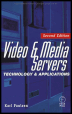
An excellent practical guide, this second edition continues to provide a technical understanding of professional digital video recording systems.
 TABLE OF CONTENTS
 The previous two chapters have explored the fundamentals of redundant arrays of independent disks from various angles. The details of RAID storage systems are becoming as fundamental as the makeup of videotape transports. Engineers of the DTV era should be conscious of the flavors and features of RAID, as they will come into contact with them in a variety of applications.
This concluding chapter on RAID will deal with a few more of the fundamentals and applications we hear so much about in video server storage systems. Following this chapter, we'll begin to look into SCSI systems and the extension of SCSI to Fibre Channel and Serial Storage Architecture (SSA). Each of these relatively new systems is finding its way into our environment in the same ways that Betacam, BetacamSP, and MII have. The impact these new storage systems will have on the future of the facility cannot be over emphasized. Stay tuned!
RAID storage can be found in non-linear edit systems, Windows NT servers, Macintosh secondary storage systems and certainly in most of the video servers being marketed in the latter half of the 1990s. Video servers depend on drives that work relentlessly to read and write video information in the form of data day in and day out. Our future in DTV will depend heavily on the video server's never-ending drive to record, process, and retrieve data over networks and conventional digital video transports.
We will look next at how striping makes up the disbursement of data...