Video and Media Servers: Technology and Applications, Second Edition
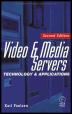
An excellent practical guide, this second edition continues to provide a technical understanding of professional digital video recording systems.
 TABLE OF CONTENTS
 As information and storage technologies continue to span the entire spectrum from PCs to mainframes, RAID applications for the storage of digital media are being implemented by every major broadcast equipment company involved in producing media server products.
The concept of RAID has been widely used and abused. Early in the video server's entree, RAID was used as a marketing tool rather than a technology per se. Confusion remains prevalent when trying to understand the numbering system applied to RAID levels. This has resulted in the myth that "the higher the RAID number, the better the performance."
This chapter begins our look into RAID. Throughout the next three chapters, we will detail the history, functionality, protection, reliability, availability, and fault tolerance capabilities of storing data on subsystems known as "redundant arrays of independent disks."
The reliability and the availability of data are the two most important requirements of a storage system. The more bulletproof you can make any storage system, the more reliable it becomes. The availability of data, on the other hand, implies that data can be stored and recovered in the most rapid, accurate fashion, and with a minimum of outside activity or interaction. Both of these requirements are essential to good system performance, whether that data is intended for the home PC, the mainframe computer, or the mission-critical media for a client's commercial that can air only once during the Super Bowl.
Since the beginning, video media, whether stored on magnetic videotape, optical or magnetic disk...