Video and Media Servers: Technology and Applications, Second Edition
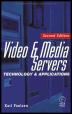
An excellent practical guide, this second edition continues to provide a technical understanding of professional digital video recording systems.
 TABLE OF CONTENTS
 In our last chapter, we introduced you to the concept of packetizing information for transmission over networks or data systems. We were concerned about the time sensitivity of delivering that information, and had begun our introduction to asynchronous transfer mode with some broad definitions and fundamentals.
This chapter will study ATM at the detail level. We will look at classes of services, layers, headers, and internal workings of the cells themselves.
Circuit switching transmission assumes some level of synchronicity. As we stated in our introduction, in order to make efficient use of available bandwidth, data is chopped up and routed in an out-of-sync or "asynchronous" way. ATM, as a data link protocol, uses asynchronous methods based on the concept of "cell switching." Cell switching combines the better parts of circuit switching and another feature called "fast packet switching."
Packet switched data networks have variable delays and use flow control mechanisms to regulate their data rates. By allowing a set of classifications to be conveyed to the network switching system, control parameters that state the importance or sensitivity of timing can determine proper delivery options. Such options may let some time sensitive data pass through at a higher priority than other types of data for which delivery timing is not particularly sensitive.
ATM is a technology that strives to provide industry with a single network concept that will support different kinds of traffic and their respective idiosyncrasies. To accomplish this, ATM supports four classes of traffic (see Table 29-1) that...