Video and Media Servers: Technology and Applications, Second Edition
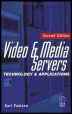
An excellent practical guide, this second edition continues to provide a technical understanding of professional digital video recording systems.
 TABLE OF CONTENTS
 A recent concept, the video/media edge-server ("edge-servers" are commonly in place for Web-enabled technology) is being experimented with in isolated instances. For example, a smaller "community server" is located at a cable head end, a translator or campus location and used for storing forward certain locale-specific content, which is inserted over a regular program stream during real time playout. This is also referred to as "drop-and-add," whereby a regional commercial may be added to the program mix that might not be fed to others in the overall DMA.
Video/media edge-servers are also deployed for video-on-demand applications, pay-per-view and the like with goal of reducing overall network or fiber traffic during high peak demand periods. These edge servers also appear in the form of commercial content receivers in place at many broadcast facilities by companies like Williams/Vyvx and DGAdvantage, and MediaDVX. These servers store forward specified content and deliver it back to the facility on an as needed or contractual basis. New versions of these servers incorporate IRDs, automation or modem interfaces, component digital embedded audio and AES interfaces (versus legacy analog-only outputs of only a couple years prior.)