Video and Media Servers: Technology and Applications, Second Edition
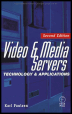
An excellent practical guide, this second edition continues to provide a technical understanding of professional digital video recording systems.
 TABLE OF CONTENTS
 An integral part of interactive television (ITV) includes the ability to selectively "order" information at will. Video-on-demand (VOD) was to be the technology for ITV. Born first from laserdisc and the VCR, VOD transformed to the magnetic disk drive as server technologies emerged from the cradle.
Video-on-demand, like ITV, made marketing promises about technology that was still in diapers. What emerged from this technological concept, when coupled with compression, networking, and computer adapted software implementation, has found exceptional acceptance in hotels, cruise ships, hospitals and educational segments of industry.
Eventually, perhaps via the Internet, perhaps as wider pipes to the home and business are deployed, many of the promises of VOD will extend to the content producer.
This chapter, which was number four in the series column, essentially remains as it was originally published in October 1994 for TV Technology. Ironically, many of the concepts developed for the creation of material aimed at VOD have already been extended to the World Wide Web. The Web and the Internet are forming supplemental and competitive models for auxiliary services for DTV. Certainly the software giants see DTV as an avenue to add features and capabilities to broadcast television. As such, the wish lists of VOD should challenge us all in the coming new millennium.
No doubt about it, the third generation of television is becoming a reality. Since its origin, television has been driven first by technology, then later by the profitability of its business worth. Now [October 1994]...