Video and Media Servers: Technology and Applications, Second Edition
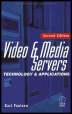
An excellent practical guide, this second edition continues to provide a technical understanding of professional digital video recording systems.
 TABLE OF CONTENTS
 The media servers discussed up to this point remain within the "video server" definition because they deal essentially with video and audio, vertical blanking interval (VBI) data, and the timecode and frame location identification, in either the analog or the digital domain. For the video server, the major concern, for the immediate pre-high definition television generation of digital, is its ability to reduce the dependence upon conventional videotape as a sole and exclusive storage medium.
Justification that leads to the eventual divorce from videotape includes issues impacting the cost and maintenance of tape transports, linear videotape inflexibility, complexities in automation and tracking systems, physical media costs, reliability of the transport and the preservation of image quality over time. In most of the broadcast facilities in 1997, the professional media server seemed to be confined principally to video-based uses. This has been of benefit to designers because it has essentially constrained the timing and resolution of the video data to a defined and understood realm.
As the move accelerates toward DTV, we will be dealing with entities far beyond 525/59.94 video. How the facility and the server handle those issues will be an entirely different matter.
Many of yesterday's concerns take on new dimensions as the recording and storage of higher bit rate signals (HDTV) become reality. Signals with data rates greater than 270 Mb/s, and a host of other compressed signals at less than 100 Mb/s, will emerge as the implementation of DTV moves forward. These signals may be...