Video and Media Servers: Technology and Applications, Second Edition
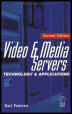
An excellent practical guide, this second edition continues to provide a technical understanding of professional digital video recording systems.
 TABLE OF CONTENTS
 The integration of video servers in mid-1990s raised questions about mixing different compression rates, networking, and measuring the quality of compressed video, and concerns over compliance, including interchange of file formats.
Many of the questions outlined in this book's first edition (1997) have since found solutions. To understand how we've solved those problems, we need to review what the questions were. In the four years since the first edition of this book, not only have the servers changed but also digital technology itself has provided new rationale for altering how we use them in real life applications.
This chapter returns to the pre-1997 perspective of living with digital, as video servers were first being brought on line in earnest.
Some manufacturers say they are offering variable compression capabilities as a feature. What this essentially means is that the user can decide whether to support full-bandwidth storage or some level of compression from 2:1 through 40:1.
For a video server, variable compression may be used as a marketing tool to enable you to store more video data. The claim is that you can mix compression levels within the storage array and obtain a lower resolution, which takes physically less drive space. Only a select few video servers offer this feature, and its use should be approached with caution.
Some servers state that you can select different compression rates, but if you look closely you find that you can only store one bit rate on the...