Video and Media Servers: Technology and Applications, Second Edition
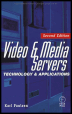
An excellent practical guide, this second edition continues to provide a technical understanding of professional digital video recording systems.
 TABLE OF CONTENTS
 In the last chapter we dealt with general issues surrounding the selection of the video server. We will continue with a deeper investigation of the considerations you'll be facing when you begin the shift to server technologies. We'll start with video compression.
The vast majority of video servers use motion-JPEG codecs as the front-end compressor and back-end decoder. Motion-JPEG or MJPEG, as is sometimes abbreviated, has developed into a solution that meets the demands of both non-linear editing and video storage for commercial broadcast applications. This is mainly because of the benefits in all intra-frame DCT coding, which is the foundation of MJPEG.
We are not going to repeat the in-depth, nitty-gritty details of video compression, as there are several good tutorials on the subject, each spanning several dozen pages. One of the better sources for a complete look into Advanced Television digital compression is S. Merrill Weiss's Issues in Advanced Television Technology. A thorough examination of digital video compression can be found in Weiss's book, Chapters 8 through 12.
In general, we understand image compression as "shortening or condensing," which for video images requires that we make two basic assumptions. First, successive video images contain redundant information repeated, unnecessary, and extraneous. This information can be encapsulated in such a way that nearly every piece of redundant content need only be expressed once, and then the system will report to the decoder, "Repeat what I've already given you x times over the next y frames." Second, the...