Video and Media Servers: Technology and Applications, Second Edition
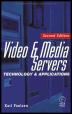
An excellent practical guide, this second edition continues to provide a technical understanding of professional digital video recording systems.
 TABLE OF CONTENTS
 When employing disk drive technologies for video-on-demand (VOD), or for any media-oriented streaming video and audio, several factors need to be considered, many of which were unavailable from a technology standpoint in 1994. The state of the art in drive technologies as we saw them in 1994 has no comparison to today's capabilities.
Keep in mind that this chapter is printed as it appeared in November 1994, the fourth article in the Media Server Technology column of TV Technology magazine. You will find some astounding statements that now, in early-1998, make no sense at all but that was the way industry viewed the future of VOD, computers, CD-ROM, and even MPEG. It is almost frightening to look back and see that most of the ideas have either been overwhelmingly surpassed or totally abandoned.
The drive for VOD is centering on home delivery and the potential for consumers to want and pay for these services. Already, they are paying for cable TV, satellite services, and movie rentals. Add in on-line services and the expansion of the commercial Internet, plus the growth of CD-ROM software and games, and you'll find there's a lot of consumer spending on entertainment leisure.
Yet some believe video-on-demand's success in the home will be limited. Predictions [made in mid-1994] stated that VOD would be less successful than existing cable, and others expected confusion, poor program selections, and overly high-priced services. Some skeptics expressed concern over complicated navigational systems that would deter all but...