Video and Media Servers: Technology and Applications, Second Edition
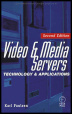
An excellent practical guide, this second edition continues to provide a technical understanding of professional digital video recording systems.
 TABLE OF CONTENTS
 Video server products developed prior to 1998 focused mainly on video and audio input/output. By late 1998, most servers incorporated baseband component digital (ITU-R 601) I/O interface and most offered AES. Component digital and AES, in general, were understood and most new facilities were incorporating the digital technology into their facilities. In applications where the servers did not have analog I/O available and where the users were adding them to an existing all analog plant, A-to-D and D-to-A converters were wrapped around the servers to integrate them into their existing environment.
At this time, from at least the broadcasters' perspective, most saw little advantage to extending the envelope to take advantage of what was on the horizon. All seemed to recognize, following the FCC DTV mandate, that preparing for the digital transition was a good idea and inevitable but the concept of delivering packetized video, or IP or some other flavor outside the conventional, and their own comfort domain, had little value. With the cost of integrating the server thrown into the equation and the push to abandon their existing automated cartridge based videotape spot playback; getting a server into the facility was a giant step forward and many saw the $100,000 investment, about all they could handle as a beginning.
There was a lot of new technology being created but not thoroughly implemented around the close of 1998. Probably the biggest concern among early server adopters following the FCC's mandate was "will my server do HD (high definition) record and...