Digital Signal Processing: Fundamentals and Applications
Chapter 3: Digital Signals and Systems

Objectives:

This chapter introduces notations for digital signals and special digital sequences that are widely used in this book. The chapter continues to study some properties of linear systems such as time invariance, BIBO (bounded-in-and-bounded-out) stability, causality, impulse response, difference equation, and digital convolution.

3.1 Digital Signals

In our daily lives, analog signals appear as speech, audio, seismic, biomedical, and communications signals. To process an analog signal using a digital signal processor, the analog signal must be converted into a digital signal; that is, analog-to-digital conversion (ADC) must take place, as discussed in Chapter 2. Then the digital signal is processed via digital signal processing (DSP) algorithm(s).

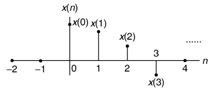
A typical digital signal x( n) is shown in Figure 3.1, where both the time and the amplitude of the digital signal are discrete. Notice that the amplitudes of digital signal samples are given and sketched only at their corresponding time indices, where x( n) represents the amplitude of the nth sample and n is the time index or sample number. From Figure 3.1, we learn that

  • x(0): zero-th sample amplitude at the sample number n = 0,

  • x(1) : first sample amplitude at the sample number n = 1,

  • x(2) : second sample amplitude at the sample number n = 2,

  • x(3): third sample amplitude at the sample number n = 3, and so on.


Figure 3.1: Digital signal notation.

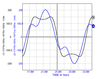
Furthermore, Figure 3.2 illustrates the digital samples...

UNLIMITED FREE
ACCESS
TO THE WORLD'S BEST IDEAS

SUBMIT
Already a GlobalSpec user? Log in.

This is embarrasing...

An error occurred while processing the form. Please try again in a few minutes.

Customize Your GlobalSpec Experience

Category: Analog-to-Digital Converters
Finish!
Privacy Policy

This is embarrasing...

An error occurred while processing the form. Please try again in a few minutes.