Digital Signal Processing: Fundamentals and Applications
Objectives:
This chapter investigates the sampling process, sampling theory, and the signal reconstruction process. It also includes practical considerations for anti-aliasing and anti-image filters and signal quantization.
As discussed in Chapter 1, Figure 2.1 describes a simplified block diagram of a digital signal processing (DSP) system. The analog filter processes the analog input to obtain the band-limited signal, which is sent to the analog-to-digital conversion (ADC) unit. The ADC unit samples the analog signal, quantizes the sampled signal, and encodes the quantized signal levels to the digital signal.
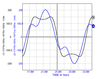
Here we first develop concepts of sampling processing in time domain. Figure 2.2 shows an analog (continuous-time) signal (solid line) defined at every point over the time axis (horizontal line) and amplitude axis (vertical line). Hence, the analog signal contains an infinite number of points.
It is impossible to digitize an infinite number of points. Furthermore, the infinite points are not appropriate to be processed by the digital signal (DS) processor or computer, since they require infinite amount of memory and infinite amount of processing power for computations. Sampling can solve such a problem by taking samples at the fixed time interval, as shown in Figure 2.2 and Figure 2.3, where the time T represents the sampling interval or sampling period in seconds.
As...