Digital Signal Processing: Fundamentals and Applications
Chapter 6: Digital Signal Processing Systems, Basic Filtering Types, and Digital Filter Realizations

Objectives:

This chapter illustrates digital filtering operations for a given input sequence; derives transfer functions from the difference equations; analyzes stability of the linear systems using the z-plane pole-zero plot; and calculates the frequency responses of digital filters. Then the chapter further investigates realizations of the digital filters and examines spectral effects by filtering speech data using the digital filters.

6.1 The Difference Equation and Digital Filtering

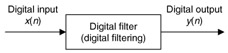
In this chapter, we begin with developing the filtering concept of digital signal processing (DSP) systems. With the knowledge acquired in Chapter 5, dealing with the z-transform, we will learn how to describe and analyze linear time-invariant systems. We also will become familiar with digital filtering types and their realization structures. A DSP system (digital filter) is described in Figure 6.1.


Figure 6.1: DSP system with input and output.

Let x( n) and y( n) be a DSP system's input and output, respectively. We can express the relationship between the input and the output of a DSP system by the following difference equation:

(6.1)

where b i, 0 ? i ? M and a j, 1 ? j ? N, represent the coefficients of the system and n is the time index. Equation (6.1) can also be written as

(6.2)

From Equations (6.1) and (6.2), we observe that the DSP system output is the weighted summation of the current input value x( n) and its past values: x( n ?

UNLIMITED FREE
ACCESS
TO THE WORLD'S BEST IDEAS

SUBMIT
Already a GlobalSpec user? Log in.

This is embarrasing...

An error occurred while processing the form. Please try again in a few minutes.

Customize Your GlobalSpec Experience

Category: Audio Analyzers
Finish!
Privacy Policy

This is embarrasing...

An error occurred while processing the form. Please try again in a few minutes.