Digital Signal Processing: Fundamentals and Applications
In electronics applications, we have been familiar with some periodic signals such as the square wave, rectangular wave, triangular wave, sinusoid, sawtooth wave, and so on. These periodic signals can be analyzed in frequency domain with the help of the Fourier series expansion. According to Fourier theory, a periodic signal can be represented by a Fourier series that contains the sum of a series of sine and/or cosine functions (harmonics) plus a direct-current (DC) term. There are three forms of Fourier series: (1) sine-cosine, (2) amplitude-phase, and (3) complex exponential. We will review each of them individually in the following text. Comprehensive treatments can be found in Ambardar (1999), Soliman and Srinath (1998), and Stanley (2003).
The Fourier series expansion of a periodic signal x( t) with a period of T via the sine-cosine form is given by
| (B.1) | |
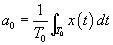
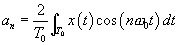
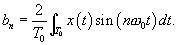
whereas ? 0 = 2 ?/T 0 is the fundamental angular frequency in radians per second, while the fundamental frequency in terms of Hz is f 0 = 1/ T 0. The Fourier coefficients of a 0, a n, and b n may be found according to the following integral equations:
| (B.2) | |
| (B.3) | |
| (B.4) | |
Notice that the integral is performed over one period of the signal to be expanded. From Equation (B.1), the signal x( t) consists of a DC term and sums of sine and cosine functions with...