Digital Signal Processing: Fundamentals and Applications

Appendix F: Some Useful Mathematical Formulas

Form of a complex number:

(F.1)
(F.2)
(F.3)

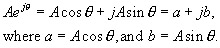
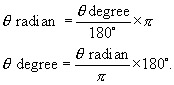
Conversion from the polar form to the rectangular form:

(F.4)

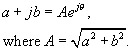
Conversion from the rectangular form to the polar form:

(F.5)

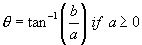
We usually specify the principal value of the angle such that ?180 < ? ? 180 . The angle value can be determined as:


(that is, the complex number is in the first or fourth quadrant in the rectangular coordinate system);


(that is, the complex number is in the second quadrant in the rectangular coordinate system); and


(that is, the complex number is in the third quadrant in the rectangular coordinate system). Note that


Complex numbers:

(F.6)
(F.7)
(F.8)

Complex conjugate of a + jb:

(F.9)

Complex conjugate of Ae j?:

(F.10)

Complex number addition and subtraction:

(F.11)

Complex number multiplication:

Rectangular form:

(F.12)
(F.13)

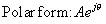
Polar form:

(F.14)

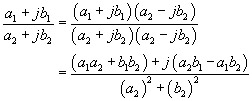
Complex number division:

Rectangular form:

(F.15)

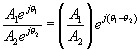
Polar form:

(F.16)

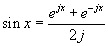
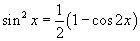
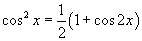
Trigonometric identities:

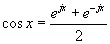
(F.17)
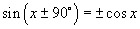
(F.18)
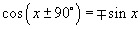
(F 19)
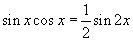
(F.20)
(F.21)
(F.22)
(E.23)
(F.24)
(F.25)
(F.26)
(F.27)
(F.28)
(F.29)

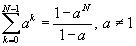
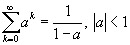
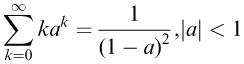
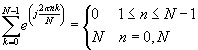
Series of exponentials:

(F.30)
(F.31)
(F.32)
(F.33)

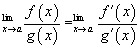
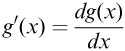
L'Hospital's rule:

If results in the undetermined form or , then,

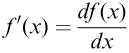
(F.34)

where and .

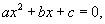
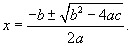
Solution of the quadratic equation:

For a quadratic equation expressed as

(F.35)

the solution is given by

(F.36)

UNLIMITED FREE
ACCESS
TO THE WORLD'S BEST IDEAS

SUBMIT
Already a GlobalSpec user? Log in.

This is embarrasing...

An error occurred while processing the form. Please try again in a few minutes.

Customize Your GlobalSpec Experience

Category: Color Meters and Appearance Instruments
Finish!
Privacy Policy

This is embarrasing...

An error occurred while processing the form. Please try again in a few minutes.