Digital Signal Processing: Fundamentals and Applications
8.6: Impulse Invariant Design Method

8.6 Impulse Invariant Design Method

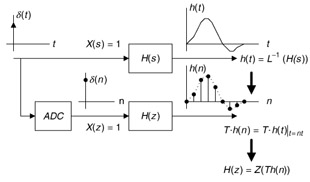
We illustrate the concept of the impulse invariant design in Figure 8.27. Given the transfer function of a designed analog filter, an analog impulse response can be easily found by the inverse Laplace transform of the transfer function. To replace the analog filter by the equivalent digital filter, we apply an approximation in time domain in which the digital impulse response must be equivalent to the analog impulse response. Therefore, we can sample the analog impulse response to get the digital impulse response and take the z-transform of the sampled analog impulse response to obtain the transfer function of the digital filter.


Figure 8.27: Impulse invariant design method.

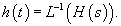
The analog impulse response can be achieved by taking the inverse Laplace transform of the analog filter H( s), that is,

(8.37)

Now, if we sample the analog impulse response with a sampling interval of T and use T as a scale factor, it follows that

(8.38)

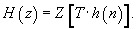
Taking the z-transform on both sides of Equation (8.38) yields the digital filter as

(8.39)

The effect of the scale factor T in Equation (8.38) can be explained as follows. We approximate the area under the curve specified by the analog impulse function h( t) using a digital sum given by

(8.40)

Note that the area under the curve indicates the DC gain of the analog filter while the digital sum in Equation (8.40) is the DC gain of the digital filter.

The rectangular approximation...

UNLIMITED FREE
ACCESS
TO THE WORLD'S BEST IDEAS

SUBMIT
Already a GlobalSpec user? Log in.

This is embarrasing...

An error occurred while processing the form. Please try again in a few minutes.

Customize Your GlobalSpec Experience

Category: Signal Conditioners
Finish!
Privacy Policy

This is embarrasing...

An error occurred while processing the form. Please try again in a few minutes.