Digital Signal Processing: Fundamentals and Applications
8.4: Higher-Order Infinite Impulse Response Filter Design Using the Cascade Method

8.4 Higher-Order Infinite Impulse Response Filter Design Using the Cascade Method

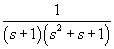
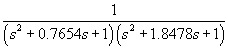
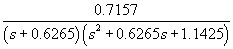
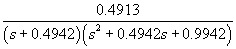
For the higher-order 11R filter design, use of a cascade transfer function is preferred. The factored forms for the lowpass prototype transfer functions for Butterworth and Chebyshev filters are given in Tables 8.7, 8.8, and 8.9. The Butterworth filter design example will be provided next. A similar procedure can be adopted for the Chebyshev filters

Table 8.7: 3 dB Butterworth prototype functions in the cascade form.

n

H P( s)

3


4


5


6


Table 8.8: Chebyshev prototype functions in the cascade form with 0.5 dB ripple ( ? = 0.3493)

n

H P( s) 0.5 dB Ripple ( ? =0.3493)

3


4


5


6


Table 8.9: Chebyshev prototype functions in the cascade form with 1 dB ripple ( ? = 0.5088).

n

H P( s) 1 dB Ripple ( ? = 0.5088)

3


4


5


6


Example 8.14.
  1. Design a fourth-order digital lowpass Butterworth filter with a cutoff frequency of 2.5 kHz at a sampling frequency of 8,000 Hz.

  2. Use MATLAB to plot the magnitude and phase responses.

Solution:

  1. First, we obtain the digital frequency in radians per second:


    Following the design steps, we compute the specifications for the analog filter.

    1. = 2.3946 10 4 rad/sec.

    2. From Table 8.7, we have the fourth-order factored prototype transfer function as


      Applying the prototype transformation, we yield


      Substituting ? a = 2.3946 x 10 4 rad/sec...

UNLIMITED FREE
ACCESS
TO THE WORLD'S BEST IDEAS

SUBMIT
Already a GlobalSpec user? Log in.

This is embarrasing...

An error occurred while processing the form. Please try again in a few minutes.

Customize Your GlobalSpec Experience

Category: IC Electronic Filters
Finish!
Privacy Policy

This is embarrasing...

An error occurred while processing the form. Please try again in a few minutes.