D.1 Sinusoidal Steady-State Response
Analysis of the sinusoidal steady-state response of digital filters will lead to the development of the magnitude and phase responses of digital filters. Let us look at the following digital filter with a digital transfer function H( z) and a complex sinusoidal input
| (D.1) | 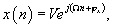
|
where ? = ?T is the normalized digital frequency, while T is the sampling period and y( n) denotes the digital output, as shown in Figure D.1.
 Figure D.1: Steady-state response of the digital filter.
 The z-transform output from the digital filter is then given by
| (D.2) | 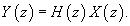
|
Since X( z) =  , we have
| (D.3) | 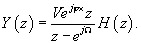
|
Based on the partial fraction expansion, Y( z)/ z can be expanded as the following form:
| (D.4) | 
|
Multiplying the factor ( z = e j?) on both sides of Equation (D.4) yields
| (D.5) | 
|
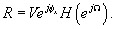
Substituting z = e j?, we get the residue as
Then substituting R = Ve j? H(e j?) back into Equation (D.4) results in
| (D.6) | 
|
and multiplying z on both sides of Equation (D.6) leads to
| (D.7) | 
|
Taking the inverse z-transform leads to two parts of the solution:
| (D.8) | 
|
From Equation (D.8), we have the steady-state response
| (D.9) | 
|
and the transient response
| (D.10) | 
|
Note that since the digital filter is a stable system, and the locations of its poles must be inside the unit circle on the z-plane, the transient response will be settled...

 TABLE OF CONTENTS