Digital Signal Processing: Fundamentals and Applications
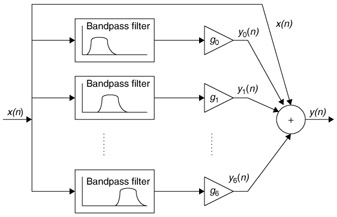
In this section, the design of a digital audio equalizer is introduced. For an audio application such as the CD player, the digital audio equalizer is used to make the sound as one desires by changing filter gains for different audio frequency bands. Other applications include adjusting the sound source to take room acoustics into account, removing undesired noise, and boosting the desired signal in the specified passband. The simulation is based on the consumer digital audio processor such as a CD player handling the 16-bit digital samples with a sampling rate of 44.1 kHz and an audio signal bandwidth at 22.05 kHz. A block diagram of the digital audio equalizer is depicted in Figure 8.24.
A seven-band audio equalizer is adopted for discussion. The center frequencies are listed in Table 8.10. The 3 dB bandwidth for each bandpass filter is chosen to be 50% of the center frequency. As shown in Figure 8.24, g 0 through g 6 are the digital gains for each bandpass filter output and can be adjusted to make sound effects, while y 0( n) through y 6( n) are the digital amplified bandpass filter outputs. Finally, the equalized signal is the sum of the amplified bandpass filter outputs and itself. By changing the digital gains of the equalizer, many sound effects can be produced.
| Center frequency... |