Digital Signal Processing: Fundamentals and Applications
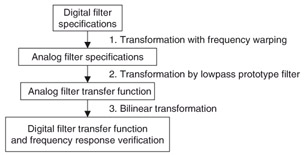
Figure 8.1 illustrates a flow chart of the BLT design used in this book. The design procedure includes the following steps: (1) transforming digital filter specifications into analog filter specifications, (2) performing analog filter design, and (3) applying bilinear transformation (which will be introduced in the next section) and verifying its frequency response.
Before we begin to develop the BLT design, let us review analog filter design using lowpass prototype transformation. This method converts the analog lowpass filter with a cutoff frequency of 1 radian per second, called the lowpass prototype, into practical analog lowpass, highpass, bandpass, and bandstop filters with their frequency specifications.
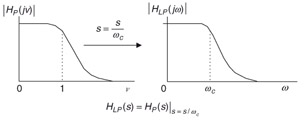
Letting H p( s) be a transfer function of the lowpass prototype, the transformation of the lowpass prototype into a lowpass filter is given in Figure 8.2.
As shown in Figure 8.2, H LP( s) designates the analog lowpass filter with a cutoff frequency of ? c radians/second. The lowpass-prototype to lowpass-filter transformation substitutes s in the lowpass prototype function H P( s) with s/ ? c , where v is the normalized frequency of the lowpass prototype and ? c is the cutoff frequency of the lowpass filter to be designed. Let us consider the following first-order lowpass prototype: