Digital Signal Processing: Fundamentals and Applications

8.7: Pole-Zero Placement Method for Simple Infinite Impulse Response Filters

8.7 Pole-Zero Placement Method for Simple Infinite Impulse Response Filters

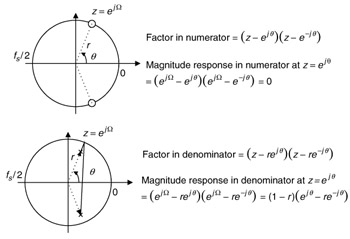
This section introduces a pole-zero placement method for a simple IIR filter design. Let us first examine effects of the pole-zero placement on the magnitude response in the z-plane shown in Figure 8.31.


Figure 8.31: Effects of pole-zero placement on the magnitude response.

In the z-plane, when we place a pair of complex conjugate zeros at a given point on the unit circle with an angle ? (usually we do), we will have a numerator factor of ( z ? e j?)( z ? e ?j?) in the transfer function. Its magnitude contribution to the frequency response at z = e j ? is ( e j ? ? e j?)( e j ? ? e j?). When ? = ?, the magnitude will reach zero, since the first factor ( e j? ? e j?) = 0 gives a zero magnitude. When a pair of complex conjugate poles are placed at a given point within the unit circle, we have a denominator factor of ( z ? re j?)( z ? re ?j?), where r is the radius chosen to be less than and close to 1 to place the poles inside the unit circle. The magnitude contribution to the frequency response at ? = ? will rise to a large magnitude, since the first factor ( e j? ? re j?) =

UNLIMITED FREE
ACCESS
TO THE WORLD'S BEST IDEAS

SUBMIT
Already a GlobalSpec user? Log in.

This is embarrasing...

An error occurred while processing the form. Please try again in a few minutes.

Customize Your GlobalSpec Experience

Category: IC Electronic Filters
Finish!
Privacy Policy

This is embarrasing...

An error occurred while processing the form. Please try again in a few minutes.