Digital Signal Processing: Fundamentals and Applications
Objectives:
This chapter introduces principles of adaptive filters and adaptive least mean square algorithm and illustrates how to apply the adaptive filters to solve real-world application problems such as adaptive noise cancellation, system modeling, adaptive line enhancement, and telephone echo cancellation.
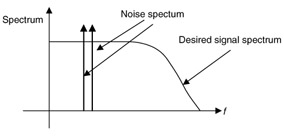
An adaptive filter is a digital filter that has self-adjusting characteristics. It is capable of adjusting its filter coefficients automatically to adapt the input signal via an adaptive algorithm. Adaptive filters play an important role in modern digital signal processing (DSP) products in areas such as telephone echo cancellation, noise cancellation, equalization of communications channels, biomedical signal enhancement, active noise control, and adaptive control systems. Adaptive filters work generally for adaptation of signal-changing environments, spectral overlap between noise and signal, and unknown, or time-varying, noise. For example, when interference noise is strong and its spectrum overlaps that of the desired signal, the conventional approach will fail to preserve the desired signal spectrum while removing the interference using a traditional filter, such as a notch filter with the fixed filter coefficients, as shown in Figure 10.1.
However, an adaptive filter will do the job. Note that adaptive filtering, with its applications, has existed for more than two decades in the research community and is still active there. This chapter can only introduce some fundaments of the subject, that is, adaptive finite impulse response (FIR) filters with a simple and popular...