Digital Signal Processing: Fundamentals and Applications
8.9: Application: 60-Hz Hum Eliminator and Heart Rate Detection Using Electrocardiography

8.9 Application: 60-Hz Hum Eliminator and Heart Rate Detection Using Electrocardiography

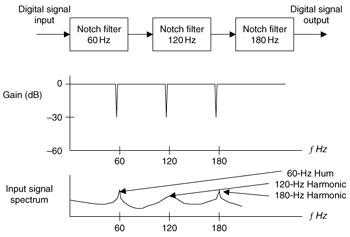
Hum noise created by poor power supplies, transformers, or electromagnetic interference sourced by a main power supply is characterized by a frequency of 60 Hz and its harmonics. If this noise interferes with a desired audio or bio-medical signal (e.g., in electrocardiography [ECG]), the desired signal could be corrupted. The corrupted signal is useless without signal processing. It is sufficient to eliminate the 60-Hz hum frequency with its second and third harmonics in most practical applications. We can complete this by cascading with notch filters having notch frequencies of 60 Hz, 120 Hz, and 180 Hz, respectively. Figure 8.41 depicts the functional block diagram.


Figure 8.41: ( Top) 60-Hz hum eliminator; ( middle) the filter frequency response of the eliminator; ( bottom) the input signal spectrum corrupted by the 60-Hz hum and its second and third harmonics.

Now let us apply the 60-Hz hum eliminator to an ECG recording system. ECG is a small electrical signal captured from an ECG sensor. The ECG signal is produced by the activity of the human heart, thus can be used for heart rate detection, fetal monitoring, and diagnostic purposes. The single pulse of the ECG is depicted in Figure 8.42, which shows that the ECG signal is characterized by five peaks and valleys, labeled P, Q, R, S, and T. The highest positive wave is the R wave. Shortly before and after the R wave are negative waves called...

UNLIMITED FREE
ACCESS
TO THE WORLD'S BEST IDEAS

SUBMIT
Already a GlobalSpec user? Log in.

This is embarrasing...

An error occurred while processing the form. Please try again in a few minutes.

Customize Your GlobalSpec Experience

Category: IC Electronic Filters
Finish!
Privacy Policy

This is embarrasing...

An error occurred while processing the form. Please try again in a few minutes.