C.1 Normalized Butterworth Function
The normalized Butterworth squared magnitude function is given by
| (C.1) | 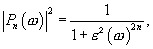
|
where n is the order and ? is the specified ripple on filter passband. The specified ripple in dB is expressed as ? dB = 20 log 10  dB.
dB.
To develop the transfer function P n( s), we first let s = j ? and then substitute ? 2 = ? s 2 into Equation (C.1) to obtain
| (C.2) | 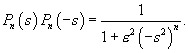
|
Equation (C.2) has 2 n poles, and P n( s) has n poles on the left-hand half plane (LHHP) on the s-plane, while P n( ? s) has n poles on the right-hand half plane (RHHP) on the s-plane. Solving for poles leads to
| (C.3) | 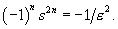
|
If n is an odd number, Equation (C.3) becomes
and the corresponding poles are solved as
| (C.4) | 
|
where k = 0, 1, , 2 n - 1. Thus in the phasor form, we have
| (C.5) | 
|
When n is an even number, it follows that
| (C.6) | 
|
where k = 0, 1, , 2 n ? 1. Similarly, the phasor form is given by
| (C.7) | 
|
When n is an odd number, we can identify the poles on the LHHP as
| (C.8) | 
|
Using complex conjugate pairs, we have
Notice that
and from a factor from the real pole ( s + r), it follows that
| (C.9) | 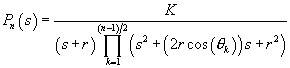
|
and


 TABLE OF CONTENTS