Digital Signal Processing: Fundamentals and Applications
Objectives:
This chapter investigates a bilinear transformation method for infinite impulse response (IIR) filter design and develops a procedure to design digital Butterworth and Chebyshev filters. The chapter also investigates other IIR filter design methods, such as impulse invariant design and pole-zero placement design. Finally, the chapter illustrates how to apply the designed IIR filters to solve real-world problems such as digital audio equalization, 60-Hz interference cancellation in audio and electrocardiography signals, dual-tone multifrequency tone generation, and detection using the Goertzel algorithm.
In this chapter, we will study several methods for infinite impulse response (IIR) filter design. An IIR filter is described using the difference equation, as discussed in Chapter 6:
Chapter 6 also gives the IIR filter transfer function as
where b i and a i are the ( M + 1) numerator and N denominator coefficients, respectively. Y( z) and X( z) are the z-transform functions of the filter input x( n) and filter output y( n). To become familiar with the form of the IIR filter, let us look at the following example.
Given the following IIR filter:
Determine the transfer function, nonzero coefficients, and impulse response.
Solution:
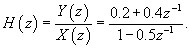
Applying the z-transform and solving for a ratio of the z-transform output over input, we have
We also identify the nonzero numerator coefficients and denominator coefficient as
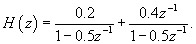
To solve the impulse response, we rewrite the transfer function as
Using...