Digital Signal Processing: Fundamentals and Applications
Chapter 5: The z-Transform

Objectives:

This chapter introduces the z-transform and its properties; illustrates how to determine the inverse z-transform using partial fraction expansion; and applies the z-transform to solve linear difference equations.

5.1 Definition

The z-transform is a very important tool in describing and analyzing digital systems. It also offers the techniques for digital filter design and frequency analysis of digital signals. We begin with the definition of the z-transform.

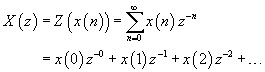
The z-transform of a causal sequence x( n), designated by X( z) or Z( x( n)), is defined as

(5.1)

where z is the complex variable. Here, the summation taken from n = 0 to n = ? is according to the fact that for most situations, the digital signal x( n) is the causal sequence, that is, x( n) = 0 for n < 0. Thus, the definition in Equation (5.1) is referred to as a one-sided z-transform or a unilateral transform. In Equation (5.1), all the values of z that make the summation to exist form a region of convergence in the z-transform domain, while all other values of z outside the region of convergence will cause the summation to diverge. The region of convergence is defined based on the particular sequence x( n) being applied. Note that we deal with the unilateral z-transform in this book, and hence when performing inverse z-transform (which we shall study later),...

UNLIMITED FREE
ACCESS
TO THE WORLD'S BEST IDEAS

SUBMIT
Already a GlobalSpec user? Log in.

This is embarrasing...

An error occurred while processing the form. Please try again in a few minutes.

Customize Your GlobalSpec Experience

Category: IC Electronic Filters
Finish!
Privacy Policy

This is embarrasing...

An error occurred while processing the form. Please try again in a few minutes.