Digital Signal Processing: Fundamentals and Applications
Objectives:
This chapter introduces basics of digital signal processors such as processor architectures and hardware units, investigates fixed-point and floating-point formats, and illustrates the implementation of digital filters in real time.
Unlike microprocessors and microcontrollers, digital signal (DS) processors have special features that require operations such as fast Fourier transform (FFT), filtering, convolution and correlation, and real-time sample-based and block-based processing. Therefore, DS processors use a different dedicated hardware architecture.
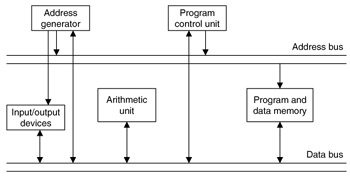
We first compare the architecture of the general microprocessor with that of the DS processor. The design of general microprocessors and microcontrollers is based on the Von Neumann architecture, which was developed from a research paper written by John von Neumann and others in 1946. Von Neumann suggested that computer instructions, as we shall discuss, be numerical codes instead of special wiring. Figure 9.1 shows the Von Neumann architecture.
As shown in Figure 9.1, a Von Neumann processor contains a single, shared memory for programs and data, a single bus for memory access, an arithmetic unit, and a program control unit. The processor proceeds in a serial fashion in terms of fetching and execution cycles. This means that the central processing unit (CPU) fetches an instruction from memory and decodes it to figure out what operation to do, then executes the instruction. The instruction (in machine code) has two parts: the opcode and the operand. The opcode specifies what the operation is, that...