
Analog Display Weather Instruments
Last Updated: April 1, 2025
Description
Analog display weather instruments are devices used to measure various atmospheric conditions and display the results using analog indicators, such as dials or needles. These instruments provide visual representations of weather data, allowing users to easily interpret changes in weather conditions.
Working Principle
Analog display weather instruments operate by detecting changes in specific atmospheric parameters and translating these changes into mechanical movements that are displayed on a dial. For example, an analog barometer measures atmospheric pressure using a mercury-filled tube; as pressure increases, it exerts more force on the mercury, causing it to rise. These instruments are useful because they provide a straightforward, real-time visual representation of weather data, which can be crucial for both short-term weather forecasting and long-term climate studies.
Applications
Analog display weather instruments are used in a variety of settings. For instance, they are commonly found in personal weather stations, where enthusiasts track local weather conditions. They are also used in educational settings to teach students about meteorology and atmospheric science. Additionally, analog barometers are often used in aviation to help pilots understand weather conditions that could affect flight.
Limitations
One limitation of analog display weather instruments is their susceptibility to user error, particularly in reading and interpreting the data displayed. Additionally, these instruments may not provide the same level of precision as digital instruments, which can be a drawback in applications requiring highly accurate measurements. Environmental factors, such as temperature and humidity, can also affect the accuracy and reliability of analog instruments.
Considerations
When considering the use of analog display weather instruments, it is important to evaluate factors such as initial costs, operating expenses, and maintenance requirements. Analog instruments are generally more affordable than their digital counterparts, but they may require more frequent calibration and maintenance to ensure accuracy. Durability is another consideration, as analog instruments can be more susceptible to wear and tear over time. Users should also consider the potential need for replacement parts and the associated costs.
from KANOMAX USA, INC.
Clear view case for ease of reading, selectable day operation [See More]
- Device Classification: Sensor System
- Temperature Range Measured: 5 to 104
- Weather Component Sensed: Measures Temperature; Measures % Relative Humidity
- Humidity Range Measured: 0.0 to 100
from Traceable® Products
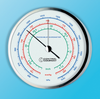
Traceable® Precision Barometer's triple scales provide a sensitive measure of atmospheric pressure from 954 to 1073 millibars, 28.1 to 31.7 inches of mercury, and 715 to 805 millimeters of mercury with a resolution of 0.5 mbar, 0.05 InHg, and 0.5 mmHg. Accuracy is ±0.5% of reading. Traceable to NIST... [See More]
- Device Classification: Sensor System
- Pressure Range Measured: 954 to 1073
- Weather Component Sensed: Measures Barometric Pressure
- Pressure Accuracy: 0.5000