
Computer Controllable Weather Instruments
Last Updated: April 1, 2025
Description
Computer controllable weather instruments are advanced devices designed to measure various atmospheric conditions. These instruments can monitor parameters such as temperature, humidity, atmospheric pressure, wind speed, wind direction, rainfall, and solar radiation. They are equipped with sensors that collect data, which can then be processed and analyzed by computers for real-time weather monitoring and forecasting.
Working Principle
These instruments operate by using a combination of sensors and computer systems to gather and process weather data. Sensors detect specific atmospheric conditions, such as temperature changes through thermocouples or humidity levels via humidity sensors. The data collected by these sensors is transmitted to a computer system, which processes the information using algorithms to provide accurate weather readings. The integration of computer systems allows for automation in data collection and analysis, making these instruments highly efficient and useful for continuous weather monitoring.
Applications
Computer controllable weather instruments are used in various fields. For instance, they are crucial in aviation for monitoring weather conditions that could affect flight safety. In agriculture, they help farmers make informed decisions about irrigation and crop protection based on weather forecasts. Additionally, these instruments are used in renewable energy sectors, such as wind farms, to optimize the placement and operation of turbines by providing detailed wind speed and direction data.
Limitations
One limitation of computer controllable weather instruments is their dependency on power sources, which can be a challenge in remote locations. Additionally, while they provide accurate data, the initial setup and calibration can be complex and require technical expertise. Environmental factors, such as extreme weather conditions, can also affect the accuracy and durability of the sensors.
Considerations
When considering the implementation of computer controllable weather instruments, several factors should be taken into account. The initial cost can be significant, especially for high-precision instruments. Operating expenses include maintenance and calibration to ensure accuracy over time. Durability is another consideration, as these instruments must withstand various environmental conditions. Accuracy is paramount, and regular maintenance is necessary to maintain it. Replacement and maintenance costs should also be factored into the overall budget, as sensors and other components may need periodic replacement to ensure optimal performance.

from StellarNet, Inc.
StellarNet Dual-DSR spectrometer systems combine two instruments to cover the ultra violet, visible and near infrared portions of the electromagnetic spectrum. The two instruments work as one creating a unified spectral graph over the entire wavelength region, 200-2300nm. The two instruments employ... [See More]
- Device Classification: Sensor System
- Wavelength Range Measured: 200 to 1700
- Weather Component Sensed: Measures solar Radiation
- Solar Detector Instrument Type: Radiometer
from KANOMAX USA, INC.
Optional windows ® software, lightweight and robust [See More]
- Device Classification: Sensor System
- Pressure Range Measured: 0.0 to 2000
- Weather Component Sensed: Measures Barometric Pressure
- Output Options: Outputs an analog voltage signal

from RainWise, Inc.
Display Console and Data Logger. The WeatherLog ® System 12 Control/Display Console was developed to meet those applications which require a large number of sensors and/or a number of extra display parameters, such as averaging, daily records, etc. Product Features. The System 12 has two serial... [See More]
- Device Classification: Sensor System
- Velocity Range Measured: 0.0 to 150
- Weather Component Sensed: Senses Wind Speed; Senses Wind Direction; Measures Rain/Snow Fall; Measures Temperature; Measures Barometric Pressure; Measures %Water or %Moisture Content; Measures Dew Point
- Resolution of Velocity: 1

from StellarNet, Inc.
The newly released StellarNet BLUE-Wave Spectrometers are fiber optic coupled instruments with a wide selection of models for  measurements in 190-1150nm wavelength ranges. Each unit contains a USB interface with a snap shot memory to provide instantaneous spectral image from the highly... [See More]
- Device Classification: Sensor System
- Wavelength Range Measured: 350 to 1150
- Weather Component Sensed: Measures solar Radiation; Measures Temperature; Measures Barometric Pressure
- Solar Detector Instrument Type: Radiometer
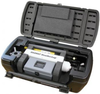
from RainWise, Inc.
The HM-1 HAZMAT weather station is designed for first responders to hazardous material incidents. The weather station provides important real-time information for monitoring and responding to incidents. The station works in conjunction with CAMEO/ALOHA software that enables responders to monitor... [See More]
- Device Classification: Sensor System
- Velocity Range Measured: 0.0 to 150
- Weather Component Sensed: Senses Wind Speed; Senses Wind Direction; Measures Temperature; Measures Barometric Pressure; Measures % Relative Humidity; Measures Dew Point
- Resolution of Velocity: 1

from StellarNet, Inc.
StellarNet's miniature fiber optic spectrometers with concave gratings deliver high performance for spectroscopy applications in the UV-VIS wavelength ranges covering 190-850nm (model C), or optionally 280-900nm (model CXR). The instruments are exceptionally robust with no moving parts, and are... [See More]
- Device Classification: Sensor System
- Wavelength Range Measured: 190 to 900
- Weather Component Sensed: Measures solar Radiation
- Solar Detector Instrument Type: Radiometer

from RainWise, Inc.
Ultrasonic Wind Sensor. A lightweight ultrasonic wind sensor, WindSonic is of a robust, high strength construction designed to withstand installation and use with no fear of the damage commonly experienced with the more fragile cups, vanes or propellers. Windsonic does not require expensive on-site... [See More]
- Device Classification: Sensor System
- Velocity Range Measured: 0.0 to 134
- Weather Component Sensed: Senses Wind Speed; Senses Wind Direction
- Resolution of Velocity: 0.0224

from StellarNet, Inc.
The StellarNet GREEN-Wave Spectrometers are fiber optic coupled instruments with a wide selection of models for measurements in 190-1150nm wavelength ranges. Each unit contains a USB interface with a snap shot memory to provide instantaneous spectral image from the highly sensitive CCD or Photo... [See More]
- Device Classification: Sensor System
- Wavelength Range Measured: 350 to 1150
- Weather Component Sensed: Measures solar Radiation; Measures Temperature; Measures Barometric Pressure
- Solar Detector Instrument Type: Radiometer

from RainWise, Inc.
MK-III Weather Station with Integrated Rain Gauge. The MK-III sensor assembly has been designed to offer improved durability and serviceability. This sleek new design is 33 inches high and weighs just over 7 pounds. It is the most accurate, durable and easiest to install weather station available. [See More]
- Device Classification: Sensor System
- Velocity Range Measured: 0.0 to 150
- Weather Component Sensed: Senses Wind Speed; Senses Wind Direction; Measures Temperature; Measures Barometric Pressure; Measures % Relative Humidity; Measures Dew Point
- Resolution of Velocity: 1
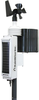
from RainWise, Inc.
Long Range MK-III Weather Station with Integrated Rain Gauge. The MK-III sensor assembly has been designed to offer improved durability and serviceability. This sleek new design is 33 inches high and weighs just over 7 pounds. It is the most accurate, durable and easiest to install weather station... [See More]
- Device Classification: Sensor System
- Velocity Range Measured: 0.0 to 150
- Weather Component Sensed: Senses Wind Speed; Senses Wind Direction; Measures Rain/Snow Fall; Measures Temperature; Measures Barometric Pressure; Measures % Relative Humidity; Measures Dew Point
- Resolution of Velocity: 1