
Video Display (CRT etc.) Weather Instruments
Last Updated: April 1, 2025
Description
Video Display Weather Instruments, such as those utilizing Cathode Ray Tube (CRT) technology, are devices that visually present weather data. These instruments convert electronic signals into visual information, allowing users to view and interpret weather-related data through a screen.
Working Principle
Cathode Ray Tube (CRT) displays operate by generating an electron beam from a cathode within a vacuum-sealed glass vessel. This beam is accelerated and directed across a phosphor-coated screen, causing the phosphors to emit visible light through a process known as cathodoluminescence. The electron beam is scanned across the screen in a raster pattern, lighting up pixels to form images. This technology is useful for weather instruments as it provides a reliable and clear visual representation of data, which is crucial for accurate weather monitoring and analysis.
Applications
CRT-based video displays are used in various weather monitoring systems. For example, they can be found in meteorological stations where they display radar images, satellite data, and other critical weather information. These displays are essential in control rooms for weather forecasting and in aviation for monitoring weather conditions that could affect flight safety.
Limitations
CRT displays have several limitations. They are bulky and heavy, making them less suitable for portable applications. The technology also consumes more power compared to modern display technologies like LCDs. Additionally, CRTs have a limited lifespan due to the degradation of the phosphor coating and the potential for burn-in, where static images can leave a permanent mark on the screen.
Considerations
When considering CRT displays for weather instruments, it is important to account for their initial cost, which can be lower than some modern alternatives. However, operating expenses may be higher due to increased power consumption. CRTs are generally durable, but their bulkiness and weight can be a drawback. Maintenance costs can also be significant, as CRTs may require periodic calibration and eventual replacement due to wear and tear. Accuracy in displaying weather data is generally reliable, but the potential for image burn-in should be considered in applications where static images are frequently displayed.

from PCE Instruments / PCE Americas Inc.
PCE-PDA 10L Anemometer for relative and differential pressure / Pitot tube adaptable to differential pressure gauge / MAX MIN function / Data logger. The differential pressure gauges of the PCE-PDA series are reliable differential pressure gauges for pressure measurement of gases in the range of... [See More]
- Weather Component Sensed: Senses Wind Speed
- Features: Battery Powered
- Instrument Display Options: Video Display (CRT etc.)

from PCE Instruments / PCE Americas Inc.
- High accuracy. - MIN/MAX function. - Compact, portable design. - Includes type K thermocouple sensor Tmax 200 °C or 392 °F. - Easy-to-read 8 mm / 0.32 in LCD screen with backlight [See More]
- Weather Component Sensed: Senses Wind Speed; Measures solar Radiation; Measures Temperature; Measures Barometric Pressure; Measures % Relative Humidity
- Instrument Display Options: Video Display (CRT etc.)
- Pressure Range Measured: 10 to 1100
- Features: Battery Powered
from Davis Instruments Corp.
Includes 8' cable for connecting junction box and console, RF filtering [See More]
- Device Classification: Sensor System
- Velocity Range Measured: 2 to 175
- Weather Component Sensed: Senses Wind Speed; Senses Wind Direction; Measures Rain/Snow Fall (optional feature); Measures Temperature; Measures Barometric Pressure; Measures % Relative Humidity (optional feature); Measures Dew Point (optional feature)
- Resolution of Velocity: 1
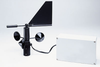
from OMEGA Engineering, Inc.
The WMS-20 series consist of three individual wind monitor stations. The WMS-21 is a microprocessor based wind alarm station. It sounds an alarm buzzer and controls the operation of two electrical circuits whenever wind speed reaches either of two independent setpoints. An LCD display provides a... [See More]
- Device Classification: Sensor System
- Velocity Range Measured: 0.0 to 100
- Weather Component Sensed: Senses Wind Speed; Senses Wind Direction
- Resolution of Velocity: 0.1000
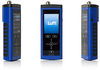
from LufftUSA
Description: The most precice and flexible all-rounder instrument for professional applications-easy to handle and robust. Allows various intelligent sensors to be connected with automatic recognition, saves measuring campaignes, allows all climate data to be calculated and archieved on a computer... [See More]
- Device Classification: Sensor System
- Pressure Range Measured: 800 to 1100
- Weather Component Sensed: Measures Temperature; Measures Barometric Pressure; Measures % Relative Humidity
- Pressure Accuracy: 0.5000 to 0.6000

from StellarNet, Inc.
StellarNet Dual-DSR spectrometer systems combine two instruments to cover the ultra violet, visible and near infrared portions of the electromagnetic spectrum. The two instruments work as one creating a unified spectral graph over the entire wavelength region, 200-2300nm. The two instruments employ... [See More]
- Device Classification: Sensor System
- Wavelength Range Measured: 200 to 1700
- Weather Component Sensed: Measures solar Radiation
- Solar Detector Instrument Type: Radiometer

from Clark Solutions
The CS-810 is a an economical service tool for use in the factory and in commercial and industrial buildings as well as laboratories for quick checking of ventilating fume hood and grill velocities. It is also useful on the farm for checking ventilation in enclosed livestock facilities. Quick... [See More]
- Device Classification: Sensor System
- Velocity Range Measured: 0.8699 to 67.11
- Weather Component Sensed: Senses Wind Speed
- Resolution of Velocity: 0.1000

from StellarNet, Inc.
The newly released StellarNet BLUE-Wave Spectrometers are fiber optic coupled instruments with a wide selection of models for  measurements in 190-1150nm wavelength ranges. Each unit contains a USB interface with a snap shot memory to provide instantaneous spectral image from the highly... [See More]
- Device Classification: Sensor System
- Wavelength Range Measured: 350 to 1150
- Weather Component Sensed: Measures solar Radiation; Measures Temperature; Measures Barometric Pressure
- Solar Detector Instrument Type: Radiometer

from StellarNet, Inc.
StellarNet's miniature fiber optic spectrometers with concave gratings deliver high performance for spectroscopy applications in the UV-VIS wavelength ranges covering 190-850nm (model C), or optionally 280-900nm (model CXR). The instruments are exceptionally robust with no moving parts, and are... [See More]
- Device Classification: Sensor System
- Wavelength Range Measured: 190 to 900
- Weather Component Sensed: Measures solar Radiation
- Solar Detector Instrument Type: Radiometer