
Universal Joints Information
Last revised: January 30, 2025
Universal joints, or u-joints are flexible mechanical connectors used to transmit rotary motion from one shaft to another shaft that is not in line with the first, or when alignment varies during service.
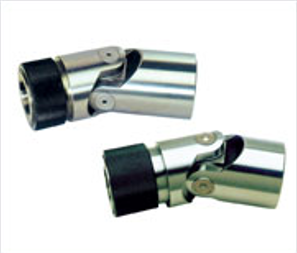
There are two types of universal joints, defined by their number of bending joints:
- Single joint: has only one bending aspect and is capable of operating at up to a 45-degree angle.
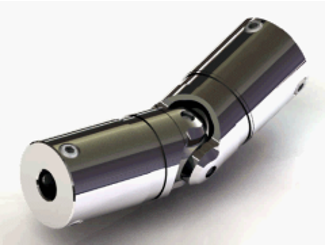
- Double joint: utilizes two bending joints, the double u-joint can operate at angles up to 90 degrees. Additionally, it also accommodate parallel offset between 2 shafts with an operating angle of the central section from 0 to 45 degrees.
Universal joints vary based on their material composition, hub type and the applications for which they are designed.
Steel is the most common material used, either in stainless form; or alloyed with other metals to handle greater torque and temperature.
Plastics and thermoplastics are often used in constructing universal joints, as this lends greater rust and corrosion resistance, as well as electrical and magnetic insulation in applications where this is required.
Hub Styles
U-joints are available with two hub styles:
- Solid: solid hub universal joints are solid and have not been machined, and as a result, do not have a hole.
- Bored: bored styles of u-joints generally derive their name from the shape of the hole in their hub, as with round, hex or square styles.
The two bored styles that deviate from the convention of round, hex or square styles are:
- Splined: has longitudinal grooves inside of the bore.
- Keyed: has keyways to prevent rotation of the u-joint on the corresponding shaft.
Specifications
Mechanical Components
Mechanical components covers a wide range of items and devices designed to handle, induce, or drive mechanical systems. In almost all cases, these components were manufactured to be part of a greater system, and do not have the ability to function on their own.
The mechanical components family includes the following products:
- Bearings and bushings
- Belts and pulleys
- Chains and sprockets
- Clutches and brakes
- Couplings
- Collars and universal joints
- Enclosures
- Fans and electronic cooling
- Gears
- Industrial heaters and heating elements
- Industrial tools
- Limit switches
- Mechanical fasteners
- Power transmission (mechanical)
- Process equipment
- Pulleys and belts
- Seals
- Solenoids
- Springs
- Switches
Power Transmission
Power transmission areas cover the wide spectrum of gears, locknuts, and other couplings that are used to secure shafts or transmit power throughout drive systems. The gears included in this family are:
- Bevel
- Herringbone
- Worm
- Helical
- Hypoid
- Miter
- Spur and strait tooth
- Gear stocks and blanks
- Belts and belt pulleys
- Sprockets
- Ratchets and pawls
All of these gears are available in both English and metric configurations.
Standards
AD 46-41-03 — Control wheel universal joints\bellanca aircrft\14-13-2\14-13.
GMI L-9A-19 — Determination of static torsional strength of universal joints and intermediate spindels (itdc release, draft for harmonization).
GOST 8059 — Universal joints with sliding liners for rolling-mill equipment. general requirements.
SAE J901 — Universal joints and driveshafts — Nomenclature — Terminology —Application
Universal Joints FAQs
What are the principles of kinematics related to universal joints?
The principles of kinematics related to universal joints can be understood through their classification as spherical crank mechanisms, which are derived from the planar four-bar linkage.
Spherical Crank Mechanisms
Universal joints are part of the family of spherical crank mechanisms. These mechanisms originate from the planar four-bar linkage when the axes of rotation are arranged to meet at a single point, creating a spherical configuration.
Four-Bar Linkage
The four-bar linkage remains movable and positively actuated even when transformed into a spherical configuration. This transformation is significant for universal joints as it allows for rotational movement while maintaining a connection between the input and output shafts.
Right-Angled, Spherical Four-Bar Linkage
When three links of the spherical four-bar linkage are set at right angles, it forms a right-angled, spherical universal joint drive. This configuration is crucial for driveshafts, as it allows for the transmission of rotational motion across varying angles.
Rotating Hooke's Joint
By fixing one of the links at an angle not equal to 90 degrees, a rotating Hooke's joint is formed. This joint is essential for applications requiring the transmission of motion through non-linear paths.
What are the different types of universal joints?
Universal joints are crucial components in mechanical systems, allowing for the transmission of rotational motion between shafts that are not in a straight line. Here are some insights into the types of universal joints and their impact on performance and efficiency:
Spherical Crank Mechanisms
Universal joints belong to the family of spherical crank mechanisms, which are derived from the planar four-bar linkage. This configuration allows for rotational movement while maintaining a connection between the input and output shafts.
Right-Angled, Spherical Four-Bar Linkage
When three links of the spherical four-bar linkage are set at right angles, it forms a right-angled, spherical universal joint drive. This configuration is significant for driveshafts, as it allows for the transmission of rotational motion across varying angles.
Rotating Hooke's Joint
By fixing one of the links at an angle not equal to 90 degrees, a rotating Hooke's joint is formed. This joint is essential for applications requiring the transmission of motion through non-linear paths.
What is the kinematic behavior of universal joints?
The kinematic behavior of universal joints is rooted in their classification as spherical crank mechanisms, which are derived from the planar four-bar linkage. Here are some key points about their kinematic behavior:
Spherical Crank Mechanisms
Universal joints are part of the family of spherical crank mechanisms. These mechanisms originate from the planar four-bar linkage when the axes of rotation are arranged to meet at a single point, creating a spherical configuration.
Four-Bar Linkage
The four-bar linkage remains movable and positively actuated even when transformed into a spherical configuration. This transformation is significant for universal joints as it allows for rotational movement while maintaining a connection between the input and output shafts.
Right-Angled, Spherical Four-Bar Linkage
When three links of the spherical four-bar linkage are set at right angles, it forms a right-angled, spherical universal joint drive. This configuration is crucial for driveshafts, as it allows for the transmission of rotational motion across varying angles.
Rotating Hooke's Joint
By fixing one of the links at an angle not equal to 90 degrees, a rotating Hooke's joint is formed. This joint is essential for applications requiring the transmission of motion through non-linear paths.
These principles highlight the kinematic behavior of universal joints, emphasizing their ability to transmit rotational motion across different planes and angles, which is vital in many mechanical systems.
What is the impact of universal joints on mechanical system efficiency?
The impact of universal joints on mechanical system efficiency can be understood through their kinematic behavior and design characteristics. Here are some insights based on the information available
Kinematic Behavior
Universal joints are classified as spherical crank mechanisms, derived from the planar four-bar linkage. This configuration allows for rotational movement while maintaining a connection between the input and output shafts.
The transformation into a spherical configuration is significant for universal joints as it enables the transmission of rotational motion across varying angles, which is crucial for driveshafts.
Types of Universal Joints
The right-angled, spherical four-bar linkage forms a right-angled, spherical universal joint drive, which is particularly significant for driveshafts. This configuration allows for the transmission of rotational motion across varying angles, enhancing the flexibility and adaptability of mechanical systems.
The rotating Hooke's joint, formed by fixing one of the links at an angle not equal to 90 degrees, is essential for applications requiring the transmission of motion through non-linear paths.
Efficiency Considerations
Universal joints can impact mechanical system efficiency by allowing for the transmission of power between misaligned shafts. However, they can introduce non-uniform motion, which may lead to vibrations and potential energy losses if not properly managed.
The design and selection of universal joints should consider the specific application requirements, including the angles of operation and the need for constant velocity, to optimize efficiency.
What are the differences between universal joints and constant velocity joints?
Here are some key differences between universal joints and constant velocity (CV) joints:
Functionality and Design
Universal Joints: These are part of the family of spherical crank mechanisms and are derived from the planar four-bar linkage. They allow for the transmission of rotational motion between shafts that are not in a straight line. Universal joints can handle significant misalignment but do not maintain constant velocity, which can lead to non-uniform motion and potential vibrations.
Constant Velocity Joints: CV joints are designed to transmit power at a constant rotational speed regardless of the angle between the input and output shafts. They consist of a cage, balls, and inner raceway encased in a housing filled with lubricating grease, which helps reduce friction and wear.
Applications
Universal Joints: Commonly used in applications where the shafts are not aligned and where some degree of misalignment is acceptable. They are often found in driveshafts and other mechanical systems requiring flexibility.
Constant Velocity Joints: Typically used in automotive applications, such as in front-wheel-drive cars, where they connect the half-axle to the front wheel. They ensure even torque transmission when the wheel moves due to steering, maintaining smooth operation.
Performance
Universal Joints: While they are effective in transmitting motion, they can introduce non-uniform motion, which may lead to vibrations and potential energy losses if not properly managed.
Constant Velocity Joints: Designed to eliminate the non-uniformity of motion, providing smoother and more efficient power transmission, especially in applications where the angle between shafts regularly varies.
What are the maintenance requirements for universal joints and CV joints?
Universal Joints Maintenance
Lubrication:
Universal joints, particularly conventional Hooke or Cardan U-joint couplings, are generally lubricated to handle medium torque capacity and speeds. Proper lubrication is crucial to minimize wear and tear and to ensure smooth operation.
Inspection:
Regular inspection is necessary to check for signs of wear, such as backlash or misalignment, which can affect performance. Ensuring that the joints are properly phased can help approximate constant velocity operation.
Sealing:
Good sealing is essential to prevent contamination and corrosion, which can significantly reduce the lifespan of the joints. Poor sealing can lead to increased wear due to contaminants entering the joint.
Constant Velocity (CV) Joints Maintenance
Lubrication:
CV joints are filled with lubricating grease, which is necessary to reduce friction among the spinning parts. This grease is encased within a rubber boot that protects the joint from contaminants.
Boot Inspection
Regular inspection of the rubber boot is crucial. Cracks or damage to the boot can allow contaminants to enter, leading to increased friction and accelerated wear of the joint.
Replacement
If the boot is damaged or if there are signs of excessive wear, it may be necessary to replace the CV joint to maintain optimal performance and prevent further damage to the drivetrain.
These maintenance practices are essential to ensure the longevity and efficiency of both universal and CV joints in mechanical systems.
Universal Joints Media Gallery
References
GlobalSpec—Universal Joints and Driveshafts: Analysis, Design, Applications
GlobalSpec—Constant Velocity Joints (CV Joints) Information
Image credits:
KTR Corporation | Oren Elliott Products, Inc. | Ondrives US Corporation
- flexible drive shaft
- drive shaft coupling
- ball joint
- small universal joints
- hex bore sprocket
- industrial u joints
- miniature universal joint
- microwave rotary joints
- articulating mechanical joint
- flexible drive
- splined coupling
- cornay u joint
- plastic universal joints
- precision universal joints
- splined universal joints
- flexible coupling in rotating shaft
- 18 GHz rotary joints
- 90 degree universal joints
- double cardan u joints
- double cardan universal joints
- dual coaxial rotary joints
- high speed universal joints
- hot oil rotary joints
- metric steering universal joints
- miniature double universal joints
- offset u joints
- radar rotary joints
- small engine universal joints
- small plastic universal joints