The Verilog Hardware Description Language, Fifth Edition

A valuable resource for engineers and students interested in modeling digital systems, this book takes a tutorial approach to presenting the major features of the language and its constructs.
 TABLE OF CONTENTS
 Using gate primitives and continuous assignment statements to specify a logic function for logic synthesis is quite straightforward. Examples 2.1 and 2.2 illustrate two synthesizable descriptions in this style. Both of the examples implement the same combinational function; the standard sum-of-products specification is:
f(a,b,c)=? m(a,b,c)=?m(1,2,3,4,7).
Essentially, logic synthesis tools read the logic functionality of the specification and try to optimize the final gate level design with respect to design constraints and library elements. Even though Example 2.1 specifies a gate level design, a logic synthesis tool is free, and possibly constrained, to implement the functionality using different gate primitives. The example shows a different, but functionally equivalent, gate level design. Here, the technology library only contained two-input gates; the synthesis tool transformed the design to the implementation on the right of the example. Other designs are possible with alternate libraries and performance constraints.
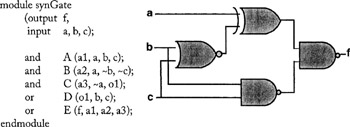
The example does not contain delay (#) information, illustrating one of the key differences between writing Verilog descriptions for simulation and synthesis. In simulation, we normally provide detailed timing information to the simulator to help the designer with the task of timing verification. A logic synthesis tool will ignore these timing specifications, using only the functional specification provided in the description. Because timing specifications are ignored, having them in a description could give rise to differences in simulating a design being input to a logic synthesis...