The Verilog Hardware Description Language, Fifth Edition

A valuable resource for engineers and students interested in modeling digital systems, this book takes a tutorial approach to presenting the major features of the language and its constructs.
 TABLE OF CONTENTS
 | 2.1 | In section 2.2 on page 37, we state that a synthesis tool is capable, and possibly constrained, to implement the functionality using different gate primitives. Explain why it might be "constrained" to produce an alternate implementation. |
| 2.2 | Alter the description of Example 2.7 so that there is no longer an inferred latch. When a is not one, b and c should be OR-d together to produce the output. |
| 2.3 | Alter the description of Example 2.16. Use a case statement to infer the latch. |
| 2.4 | Why can't while and forever loops be used to specify combinational hardware? |
| 2.5 | Rewrite Example 2.21 as a Moore machine. An extra state will have to be added. |
| 2.6 | Rewrite Example 2.21 using a one-hot state encoding. Change the description to be fully parameterized so that any state encoding may be used. |
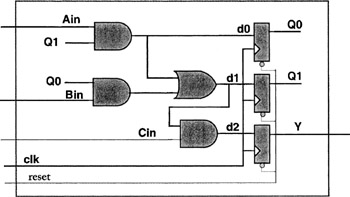
| 2.7 | Write a description for the FSM shown in Figure 2.7 with inputs Ain, Bin, Cin, clock, and reset, and output Y.
|