Electrodynamics: An Introduction Including Quantum Effects
Chapter 2: Electrostatics - Basic Aspects

2.1 Introductory Remarks

In this chapter the Coulomb law is introduced, and various static consequences are investigated, such as electrical screening and diverse applications. The latter require also the introduction of essential mathematics, in particular that of the delta distribution.

2.2 The Coulomb Law

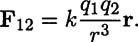
Electrostatics is the theory of static charges, which means that moving charges, i.e. currents, are not considered. The fundamental phenomenological law which is the basis of electrostatics is Coulomb's law, which determines the force acting between two point charges q 1, q 2 and which in vacuum is given by


Here r = r 1 ? r 2 is the vectorial separation of the charges q i at positions r i. k is the constant fixed by the choice of units. In the ISU, as explained in Chapter 1,


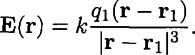
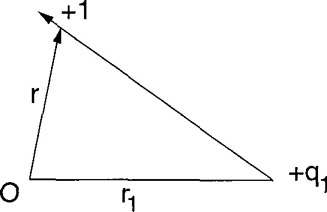
in vacuum. The force is given in newtons (N), the charge in coulombs (C) and the separation in meters (m). The electric field strength E(r) at a point r as in Fig. 2.1 is defined as the Coulomb force acting on a unit charge (+1C) at this point, i.e.


Figure 2.1: Point charges q 1 and +1.

In the ISU or MKSA-system of units the electric field strength is given in units of N/C or V/m. In the Gaussian system the charge is given in statcoulombs, the distance in cm, the force in dynes, and the electric field strength in statvolt/cm (1 C =...

UNLIMITED FREE
ACCESS
TO THE WORLD'S BEST IDEAS

SUBMIT
Already a GlobalSpec user? Log in.

This is embarrasing...

An error occurred while processing the form. Please try again in a few minutes.

Customize Your GlobalSpec Experience

Category: Ionizers and Static Eliminators
Finish!
Privacy Policy

This is embarrasing...

An error occurred while processing the form. Please try again in a few minutes.