Electrodynamics: An Introduction Including Quantum Effects

Chapter 16: Causality and Dispersion Relations

16.1 Introductory Remarks

In this chapter we continue the study of analytic properties of spectral functions, but concentrate on Green's functions and causality. In this connection important integral relations between real and imaginary parts of spectral functions are introduced, which are also known as dispersion relations or (in more mathematical contexts) as Hilbert transforms, and were first applied by Kramers to the dielectric susceptibility.

16.2 Cause U and Effect E

We let U( t) represent a cause, e.g. a charge distribution which varies with time, and E( t) an eflect, e.g. an electromagnetic field. Since both are real physical quantities, we assume them to be real.

The Fourier transforms of the two quantities define other representations of U( t) and E( t):


Since we demand that U and E are real, i.e.


it follows that


i.e.


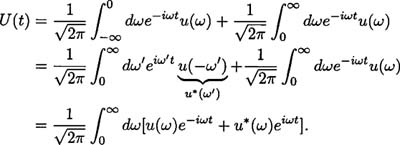
These relations between the integrands of the Fourier transforms or spectral functions are referred to as "crossing relations". One should note that ? is assumed to be real. For U( t), for instance, it follows that


We set


where r( ?), ?( ?) are real. Then


i.e. the Fourier representation of U( t) depends only on positive frequencies ( ? > 0). A corresponding result can be obtained for E( t).

16.3 ( U, E)-Linearity and Green's Functions

We let U i be the...

UNLIMITED FREE
ACCESS
TO THE WORLD'S BEST IDEAS

SUBMIT
Already a GlobalSpec user? Log in.

This is embarrasing...

An error occurred while processing the form. Please try again in a few minutes.

Customize Your GlobalSpec Experience

Category: Spectroradiometers
Finish!
Privacy Policy

This is embarrasing...

An error occurred while processing the form. Please try again in a few minutes.