Electrodynamics: An Introduction Including Quantum Effects

Chapter 3: Applications of Electrostatics

3.1 Introductory Remarks

In the following we investigate further extensions of electrostatics as well as more complicated applications, thereby also emphasising the methodical differences. Green's theorems and Fourier transforms are introduced, and finally the multipole expansion of the potential of a charge distribution is derived.

3.2 Method I: The Gauss Law

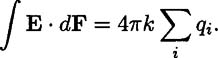
The problems we considered thus far were mostly treated with the help of the integral form of the Gauss law, and so with


We now investigate other methods.

3.3 Method II: Poisson and Laplace Equations

In the preceding we encountered the Poisson equation as the equation


In solving this equation we require boundary conditions. These are:

(1) ? = const. on conducting surfaces (in an ideal conductor the electrons do not perform work) with the discontinuity for the derivatives as for the electric field strength, i.e. (cf. Eq. (2.16))


(2) otherwise ? continuous (this is no contradiction with the difference of the potential on both sides of a dipole layer; [*] the potential of a dipole p is, as we shall see later, p r/ r 3, and this is continuous in r (no step function ?( x)). If ? were discontinuous anywhere, i.e. if ? contained a step-function ?( x ? x 0), then at this point E = ? ? ? would be proportional to ?( x ? x 0), i.e. infinite, which would be meaningless and...

UNLIMITED FREE
ACCESS
TO THE WORLD'S BEST IDEAS

SUBMIT
Already a GlobalSpec user? Log in.

This is embarrasing...

An error occurred while processing the form. Please try again in a few minutes.

Customize Your GlobalSpec Experience

Category: Pressure Sensors
Finish!
Privacy Policy

This is embarrasing...

An error occurred while processing the form. Please try again in a few minutes.