Electrodynamics: An Introduction Including Quantum Effects

14.7: Alternative Treatment using Scalar and Vector Potentials

14.7 Alternative Treatment using Scalar and Vector Potentials

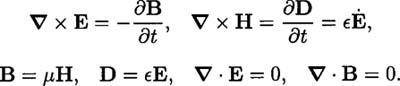
Our first step is to search for equations for E, B in terms of the scalar potential ? and the vector potential A. Again we assume that the interior of the wave guide is filled with some homogeneous material with electromagnetic constants ?, ?(e.g. those of the vacuum). Then inside the wave guide the following equations apply


But, we also have


and


and


Hence we can write


Now that we are using the vector potential A, we still have the freedom to choose some gauge fixing condition. We choose again (as in our treatment of the Lihard-Wiechert potentials) the Lorentz gauge, i.e. we set


Then


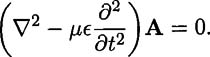
With the ansatz A ? e ? i ? t (as above for E, H) the following equation results


Hence from Eq. (14.101):


with


Equations (14.103) and (14.104) show: E, B can be derived from A, which is a solution of Eq. (14.102).

We consider now the TM and TE cases separately.

  1. TM: B z = 0 everywhere.

    We set


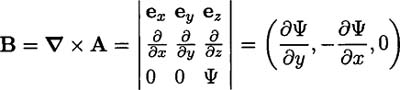
    Then


    and from Eq. (14.103),


    i.e.


    However, we still have the equation ? E = 0, i.e. from Eq. (14.103)


    and this is satisfied in view of Eq. (14.102), for A = (0, 0, ?), i.e.


    All fields can now be derived from the one scalar function ?, which is a solution of this equation. The function ?

UNLIMITED FREE
ACCESS
TO THE WORLD'S BEST IDEAS

SUBMIT
Already a GlobalSpec user? Log in.

This is embarrasing...

An error occurred while processing the form. Please try again in a few minutes.

Customize Your GlobalSpec Experience

Category: Oxidation Reduction Potential (ORP) Instruments
Finish!
Privacy Policy

This is embarrasing...

An error occurred while processing the form. Please try again in a few minutes.